A multidirectional literary practice

Kristin Dykstra is an award-winning writer, literary translator, and interdisciplinary scholar. She traces the restlessness, curiosity, and drift of contemporary culture in the Americas.
Dissonance, Dykstra’s 2025 collection of prose poems from the University of Chicago Press, won the Phoenix Emerging Poet Book Prize and was a Finalist for the Vermont Book Award.
Dykstra has published numerous books of translations, bringing new voices into English from Cuba, Uruguay, Chile, Peru, and Mexico. She has also highlighted works published in Spanish by writers residing in the United States, including in Vermont. Among Dykstra’s professional recognitions are the PEN Award for Poetry in Translation and a National Endowment for the Arts Literary Translation Fellowship.
Dykstra gathers essential context about contemporary writers and their contributions to our time, as well as recovering works from the past. She publishes essays in various formats as well as scholarship. In 2024, her chapter on Cuban poetry 1959-1989 was published in The Cambridge History of Cuban Literature. Other scholarly chapters and articles examine works by writers in the US and various other nations of the Americas.
While teaching in the Department of English at Illinois State University (2002-2014), where she entered as an Assistant Professor and left as Full Professor, Dykstra won the 2007-8 Dean’s Award for Outstanding Scholarly Achievement and a 2005-6 College of Arts and Sciences Teaching Initiative Award. Currently she is Distinguished Scholar in Residence at Saint Michael’s College in Vermont.
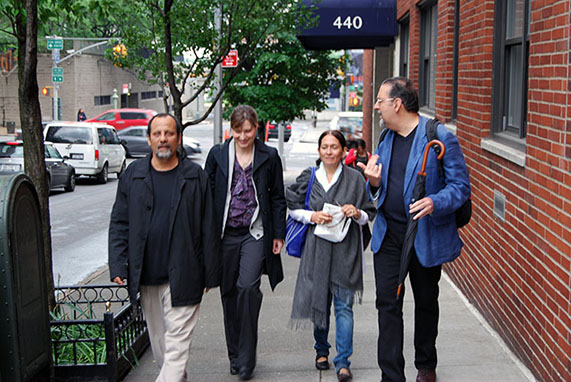
Juan Carlos Flores, Kristin Dykstra, Reina María Rodríguez, and Rolando Sánchez Mejías on the way to a 2011 reading in New York.